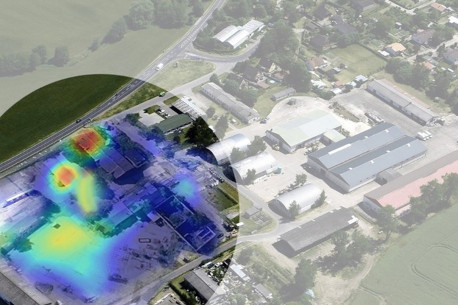
Dürrbeck, K.;Gollapalli, K., Reich, D.; Veres-Homm, U.; Obaidullah, Sk.; Fischer, R.: Change Detection for Sustainable Redevelopment of AI Identified Brownfields from Satellite Imagery using Statistical and Clustering Techniques - A Case Study on Supply Chain Location Analysis, HAWAII INTERNATIONAL CONFERENCE ON SYSTEM SCIENCES 2025 (HICSS-58). Link: https://scholarspace.manoa.hawaii.edu/items/835e5a31-d394-45dc-9857-699f56a810b7
Konrad D.; Asifuzzaman L.; Md Obaidullah Sk; Roland, F. : EcoBrownfieldNet: Brownfield Identification from Satellite Remote Sensing Imagery towards Sustainable Development - An Artificial Intelligence-based Framework, 3rd International Conference on Advanced Computing and Applications (ICACA 2024). Link: https://link.springer.com/book/10.1007/978-981-97-4799-3
Veres-Homm, U.; Nehm, A.; Waibel, C.; Logix Initiative Logistikimmobilien (Hrsg.) (2024): Logistikimmobilien – Dreh- und Angelpunkte der Supply Chain. Link: https://logix-award.de/publikationen
Veres-Homm, U.; Nehm, A.; Kille, C.; Waibel, C.; Aurelis Real Estate GmbH (Hrsg.) (2024): Whitepaper: Logistiknachfrage in Deutschland - Perspektive 2025-2028. Link: https://aurelis.de/whitepaper-logistiknachfrage-in-deutschland
Union Investment; Fraunhofer IIS (Hrsg.): Standortfaktor Arbeitskräfte: Strukturen, Potentiale & Handlungsfelder für die Logistikimmobilie, 2024. Link: https://realestate.union-investment.com/media-center/pressemitteilungen/marktstudie-logistik
Jacobi, C; Kruschina, D.; Nehm, A.; Veres-Homm, U.; Logix Initiative Logistikimmobilien (Hrsg.) (2020): Klimabilanz – Impulse für die Logistikimmobilien-Wirtschaft. Link: https://logix-award.de/publikationen
Nehm, A.; Veres-Homm, U.; Logix Initiative Logistikimmobilien (Hrsg.) (2018): Standortkompass – Flächen und Beschäftigungspotentiale in den deutschen Logistikregionen. Link: https://logix-award.de/publikationen
Veres-Homm, U.; Weber, N.; Logix Initiative Logistikimmobilien (Hrsg.) (2016): Logistikimmobilien – Dreh und Angelpunkte der Supply Chain. Link: https://logix-award.de/publikationen
Kübler, A.; Distel, S.; Veres-Homm, U. (2015): Logistikbeschäftigung in Deutschland – Vermessung, Bedeutung und Struktur.
Veres-Homm, U. (2017): Erfolgreiche Logistikstandorte – Rahmenbedingungen und Ansiedlungsdynamik, in: Münchow: Malte-Maria: Kompendium der Logistikimmobilie – Entwicklung, Nutzung und Investment.
Veres-Homm, U.; Kübler, A.; Weber, N.; Cäsar, E. (2015): Logistikimmobilien – Markt und Standorte 2015.
Krupp, T; Suntrop, C.; Kille, C.; Veres-Homm, U.; Heeg, L.; Bundesvereinigung Logistik (Hrsg.) (2013): Chemielogistik – Bedeutung, Strukturen, Dynamik.